
Most contact centre assessments rest on the same foundation: an experienced consultant pulls a client's data, recognises patterns from years of prior engagements, and writes up findings. The expertise is real. The problem is everything around it.
That process is slow — weeks of pulling exports, reconciling inconsistent column names, and hand-scoring queue after queue. It is inconsistent — two skilled assessors looking at the same data will weight it differently and reach different conclusions. And it is hard to defend — when a client pushes back on a finding, "in my experience" is not a satisfying answer.
We built the Queue Health Index to fix all three problems without losing the expertise that makes the assessment valuable in the first place.
What the Queue Health Index is
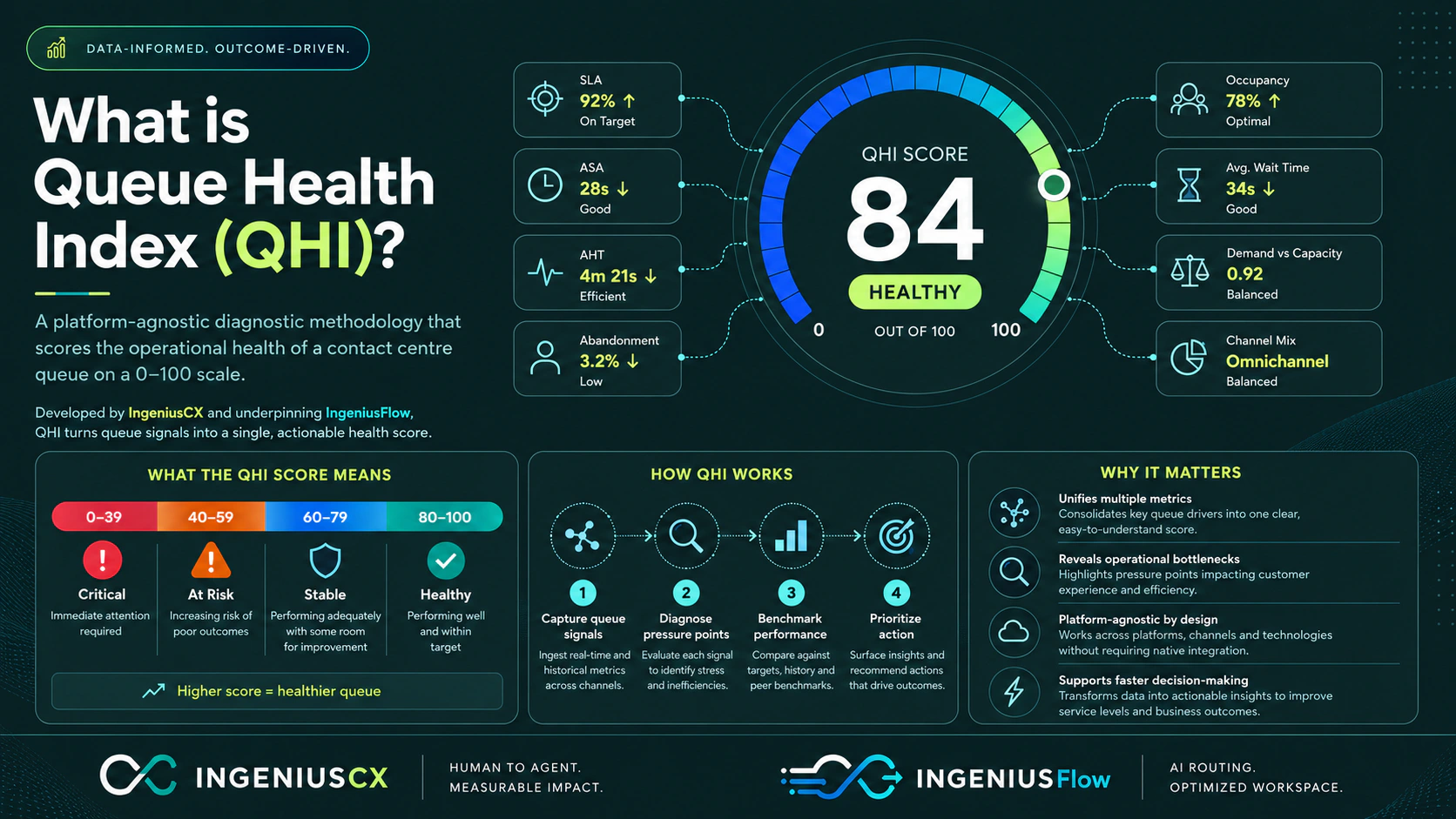
The Queue Health Index (QHI) is a diagnostic methodology that scores the operational health of a contact centre queue on a 0–100 scale, where a higher score means a healthier queue. It assesses each queue across five operational dimensions, combines four of them into a single composite score, and attaches a confidence level to every number it produces.
QHI is the methodology. IngeniusFlow is the engine that runs it — ingesting raw queue exports and turning them into ranked, client-ready findings in hours rather than weeks.
The goal is simple: keep the judgement of an experienced operations consultant, but make it repeatable, consistent, and defensible.
Why a contact centre needs a health index
Contact centres are complex operational systems, and complexity hides problems. A queue that looks fine on a surface-level service-level report can be quietly burning out agents, leaking demand through avoidable transfers, or carrying years of accumulated configuration debt that nobody has had time to clean up.
The trouble is that these problems live in different places and get measured with different instincts. One assessor fixates on handle time, another on abandonment, another on routing. Without a shared framework, the assessment reflects the assessor as much as the queue.
A health index fixes that by defining, up front, what "healthy" means and how each signal contributes to it. It turns a collection of individual judgements into a single, consistent scoring system — the same way a credit score turns a messy financial history into one comparable number, while still letting you see the factors underneath.
The five dimensions QHI measures
QHI scores each queue across five operational dimensions. Four are health dimensions that combine into the composite score. The fifth, Automation Potential, is scored separately as a forward-looking opportunity rather than a health signal.
Configuration Health measures the structural cleanliness of a queue — how much accumulated configuration debt it carries in the form of redundant queues, overlapping skills, and bloated wrap-up code taxonomies.
Routing Health measures how effectively contacts reach the right destination, and whether the routing design still matches the actual mix of contacts arriving.
Agent Experience measures the operational conditions agents work under — the after-call work, transfers, and handling pressure that quietly degrade both wellbeing and quality.
Operational Efficiency measures how well a queue converts effort into resolved contacts, separating queues that are merely fast from queues that are genuinely effective.
Automation Potential measures how suitable a queue is for self-service, deflection, or AI-assisted handling. It sits alongside QHI rather than inside it, because automatability is a separate question from health — a queue can be healthy and highly automatable, or unhealthy and a poor candidate for automation.
Why automation is scored separately
This is a deliberate design choice worth dwelling on, because it is where a lot of contact centre scoring goes wrong.
It is tempting to fold "how automatable is this queue" into an overall health score. But the two measure fundamentally different things. Health asks: is this queue working well right now? Automation Potential asks: could this queue be handled differently in future? A high-volume billing queue might be both perfectly healthy and an excellent automation candidate. Another queue might be deeply unhealthy precisely because it is handling work that should have been automated years ago.
Blend those signals into one number and you lose the meaning of both. So QHI keeps them distinct: a health score that tells you what to fix, and an Automation Potential score that tells you where the future opportunities are.
Every score carries its own confidence
A score that fires is not the same as a finding worth acting on. This is the difference between a number and an insight, and most scoring tools ignore it.
QHI computes a confidence level for every dimension and for the composite, based on how complete the underlying data is, how large the sample is, and how decisively the signals point in one direction. A queue with very low volume still receives a score — but that score carries low confidence rather than being suppressed or, worse, fabricated.
This matters because the alternative — silently treating a thin-data queue as if it were certain — is exactly how automated assessments lose the trust of the consultants who rely on them. Confidence travels with the score, so the person using it always knows how much weight to place on it.
A shared language for problems
Beneath the dimension scores, QHI detects specific, named operational patterns. Naming them is not cosmetic — it gives consultants and clients a shared vocabulary for problems that are otherwise described in vague, unmemorable terms.
When a queue has more queues than its volume warrants, that is Queue Sprawl. When routing assignments have drifted away from the actual contact mix, that is Routing Drift. When after-call work is consuming agent capacity beyond healthy norms, that is Wrap-Up Drag. When contacts circulate between queues without resolution, that is a Transfer Loop.
These names let a finding land. "Your billing queue shows Routing Drift" is a sentence a client remembers and acts on. "The routing seems a bit off" is not.
Built to work with any platform
QHI does not depend on any single platform's features. It works from the queue-level metrics that every contact centre platform can export — handle time, after-call work, abandonment, transfers, service level, and volume — normalised into a consistent internal representation before any scoring happens.
A client running Genesys, Connect, CXone, or an on-premise system that predates all three can be assessed with the same methodology and compared on the same scale. Platform-agnostic is not a feature we added later; it is how the methodology was designed from the start.
Where this goes next
The Queue Health Index is the foundation. Over the coming months we will go deeper on the individual patterns it detects — what causes them, how to spot them in your own data, and what to do about them. Each one is a recurring story in contact centre operations, and each one is worth understanding whether or not you ever run a formal assessment.
If you want to see what QHI reveals about your own queues, or use IngeniusFlow in your own consulting work, we would like to hear from you.
Key points
The Queue Health Index and IngeniusFlow are developed by IngeniusCX.