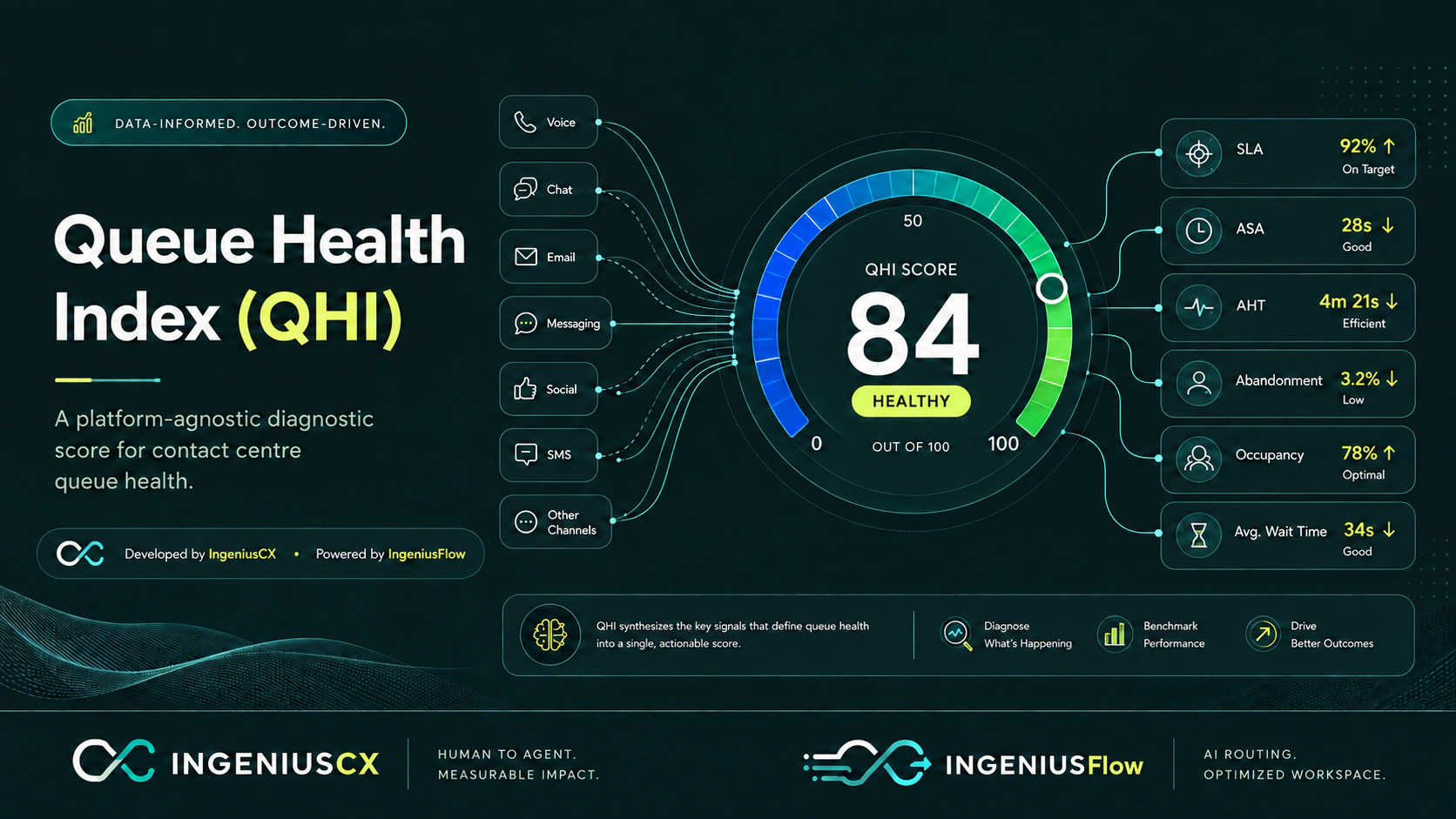
The Queue Health Index (QHI) is a diagnostic methodology developed by IngeniusCX that scores the operational health of a contact centre queue on a 0–100 scale, where a higher score indicates a healthier queue. It is the framework that underpins IngeniusFlow, and it is platform-agnostic by design — it works from the queue telemetry that any CCaaS or on-prem contact centre platform can export, including ( but not limited to) Genesys Cloud, Amazon Connect, and CXone.
This page explains what QHI measures, how it works, and why it produces assessments that a consultant can defend to a client.
Why contact centre diagnostics needed a methodology
Most contact centre assessments are built on judgement and experience. A consultant pulls a client's queue exports, looks at the numbers, recognises patterns from years of prior engagements, and writes up findings. The insight is real, but the process has three weaknesses: it is slow, it is inconsistent between assessors, and it is hard to defend when a client challenges a finding.
QHI exists to keep the expert judgement while removing those three weaknesses. It encodes the patterns an experienced operations consultant looks for into a repeatable, scored, confidence-weighted framework. The result is an assessment that is faster to produce, consistent across queues and assessors, and defensible because every score traces back to the specific signals that produced it.
What QHI measures: five operational dimensions
QHI assesses each queue across five distinct operational dimensions. Four of them are health dimensions that combine into the composite QHI score. The fifth, Automation Potential, is scored separately as a forward-looking opportunity metric rather than a health signal.
Configuration Health
Configuration Health measures the structural cleanliness of a queue — how much accumulated configuration debt it carries. Over time, contact centres accumulate redundant queues, overlapping agent skills, and bloated wrap-up code taxonomies. Each addition seems reasonable in isolation, but the cumulative effect is a configuration that is harder to manage, harder to route through, and harder to report on. Configuration Health quantifies that accumulated debt.
Routing Health
Routing Health measures how effectively contacts reach the right destination. When routing logic drifts away from the actual mix of contacts arriving, customers wait longer, get transferred more often, and abandon more frequently. Routing Health captures whether the routing design still matches operational reality.
Agent Experience
Agent Experience measures the operational conditions agents work under. Excessive after-call work, constant transfers, and unsustainable handling pressure degrade both agent wellbeing and the quality of customer interactions. This dimension surfaces the queues that are quietly burning out the workforce.
Operational Efficiency
Operational Efficiency measures how well a queue converts effort into resolved contacts. A queue can be fast but ineffective — handling contacts quickly while failing to resolve them, leaking demand through transfers and abandonment. Operational Efficiency separates speed from effectiveness and scores the latter.
Automation Potential
Automation Potential is scored alongside QHI rather than inside it. It measures how suitable a queue is for self-service, deflection, or AI-assisted handling. It is deliberately kept separate from the health composite because automatability is orthogonal to health — a queue can be healthy and highly automatable, or unhealthy and a poor automation candidate. Folding opportunity into a health index would blur both signals, so QHI keeps them distinct.
How the composite QHI score is built
The composite QHI score combines the four health dimensions into a single 0–100 number. Each dimension is first normalised so that higher always means healthier, then combined using a weighting that reflects relative customer impact — routing and efficiency problems tend to reach the customer faster and harder than structural configuration debt, so they carry more weight in the composite.
The headline QHI score is always presented alongside its four contributing dimension scores. The composite tells you which queues need attention; the dimensions tell you why. A consultant never has to defend a single opaque number — the breakdown is always visible.
Confidence: every score knows how much to trust itself
A score that fires is not the same as a finding worth acting on. QHI computes a confidence level for every dimension and for the composite, based on how complete the underlying data is, how large the sample is, and how decisively the signals point in one direction.
This matters most for small queues. A queue with very low volume still receives a score, but that score carries low confidence rather than being suppressed or zeroed. The methodology never fabricates certainty it does not have, and it never discards a queue simply because the data is thin. Confidence travels with the score so the consultant always knows how much weight to place on it.
Named patterns: the language of the diagnosis
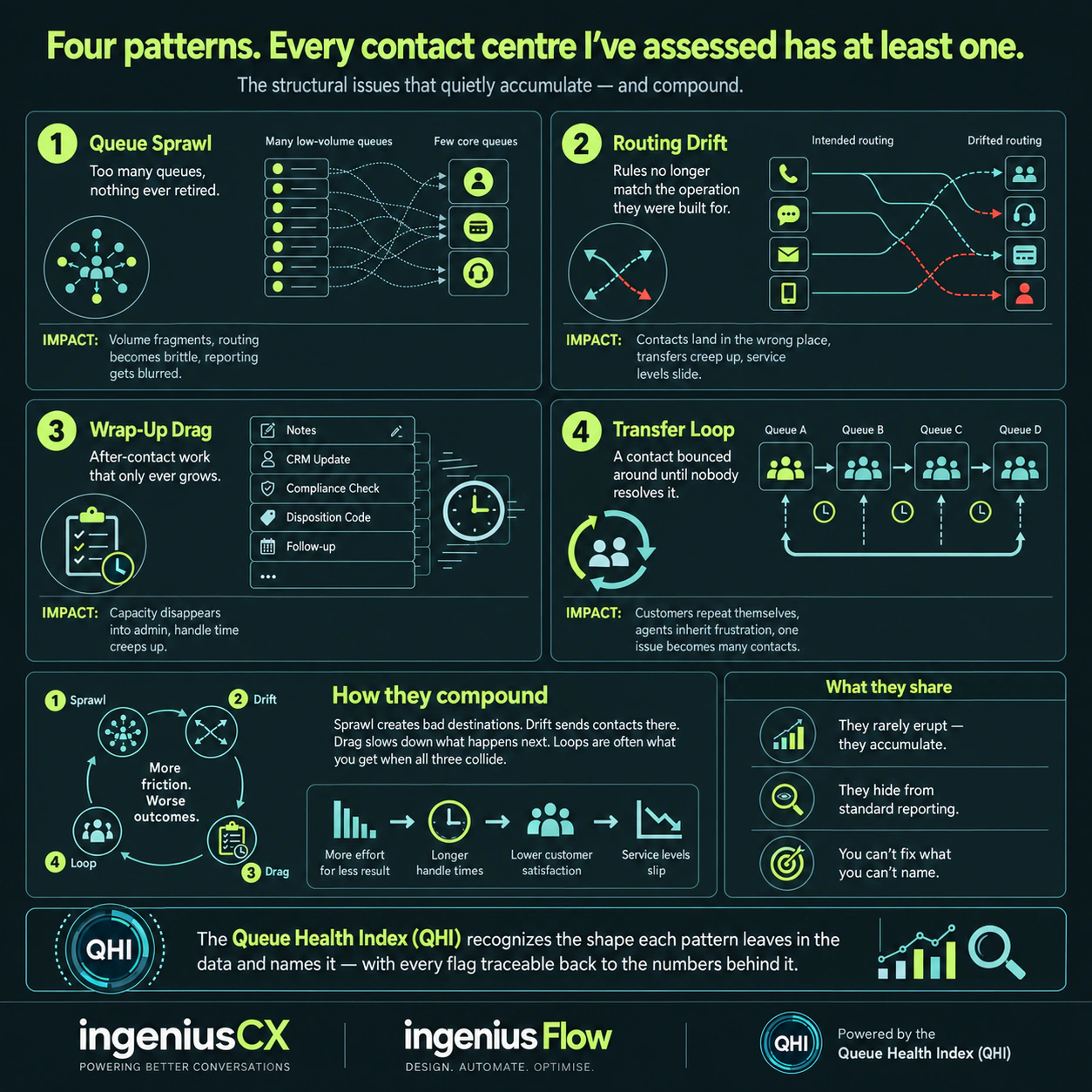
Beneath the dimension scores, QHI detects specific, named operational patterns. Naming them matters — it gives consultants and clients a shared vocabulary for problems that are otherwise described in vague terms. The QHI pattern library includes recurring anti-patterns such as:
- Queue Sprawl — more queues than the volume profile warrants
- Skill Sprawl — agents assigned overlapping or excessive skills
- Code Sprawl — wrap-up code taxonomies bloated past usefulness
- Routing Drift — routing assignments that no longer match the contact mix
- Transfer Loop — contacts circulating between queues without resolution
- Self-Service Gap — high-volume contact types with no deflection path
- Wrap-Up Drag — after-call work consuming agent capacity beyond healthy norms
- Transfer Churn — agents repeatedly handing off contacts they should resolve
- Capacity Leak — staffed agent time going unconverted during demand
These patterns roll up into the dimension scores, but they are also surfaced individually, because the named pattern is often what a consultant builds a recommendation around.
Platform-agnostic by design
QHI does not depend on any single platform's features. It works from the queue-level metrics that every contact centre platform can produce — handle time, after-call work, abandonment, transfers, service level, and volume — normalised into a consistent internal representation before any scoring happens. A client running Genesys, Connect, CXone, or an on-premise system that predates all three can be assessed with the same methodology and compared on the same scale.
Where QHI fits
QHI is the methodology. IngeniusFlow is the diagnostic engine that runs it — ingesting raw queue exports and producing scored, ranked, client-ready findings in hours rather than weeks. For consultants, boutique CX agencies, and operations leaders, QHI provides the rigour of a repeatable framework with the speed of an automated engine, and the defensibility of an assessment where every number can be traced back to the signal that produced it.
The Queue Health Index and IngeniusFlow are developed by IngeniusCX.