
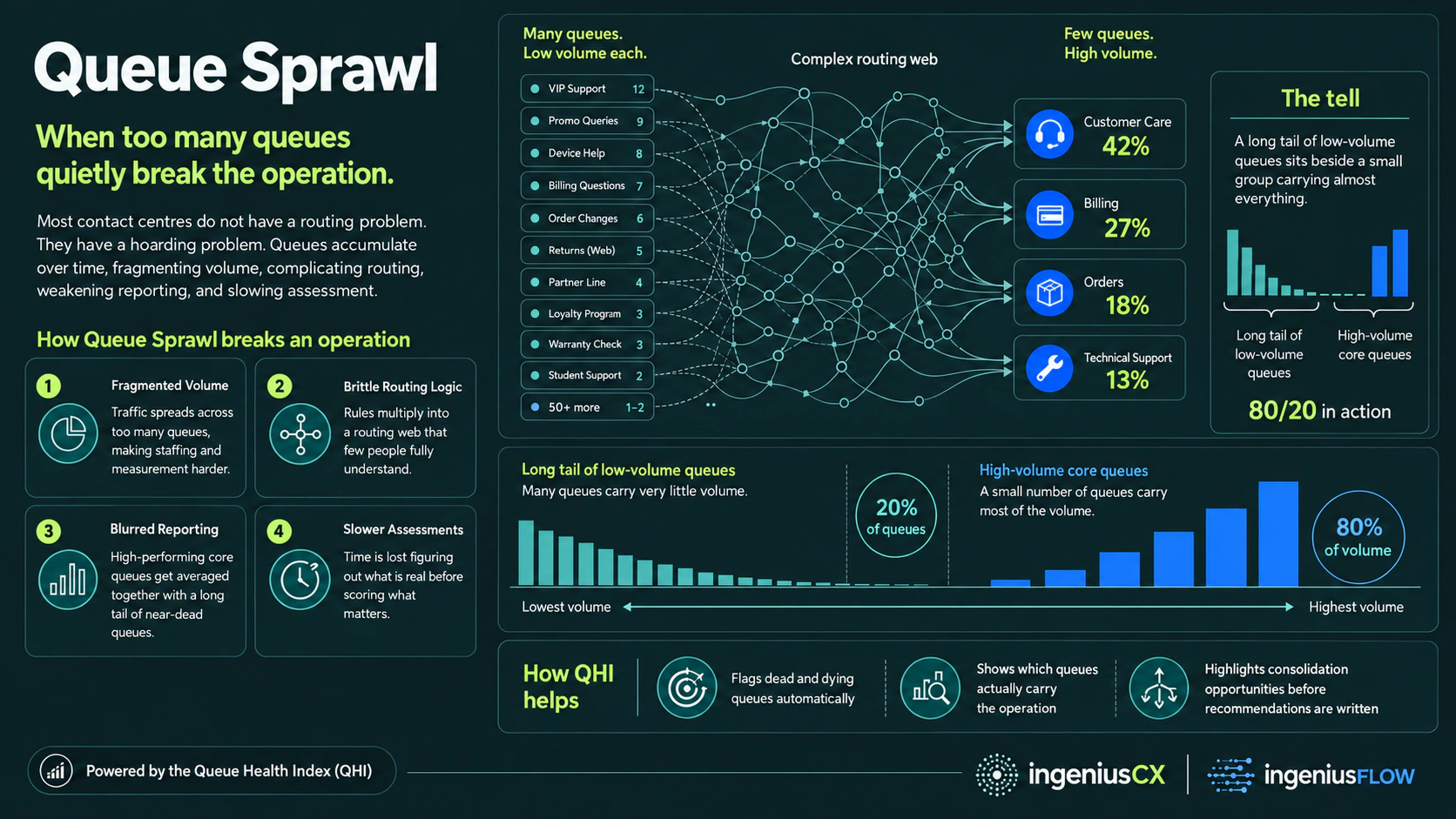
Most contact centre problems get diagnosed as routing problems. A call lands in the wrong place, a customer waits too long, an agent fields something outside their skill — and the conclusion is usually "fix the routing."
But underneath a surprising share of routing pain sits something simpler and more structural: there are just too many queues. Not too many calls, too many queues. And almost nobody ever decided to have them all.
We call this Queue Sprawl, and it's the first of the named patterns the Queue Health Index is built to surface.
What Queue Sprawl is
Queue Sprawl is the gradual accumulation of more queues than an operation actually needs to run — the result of years of additions without any matching retirements.
No single decision creates it. It accretes. Every campaign gets a queue. Every product launch gets a queue. Every "let's just route this somewhere for now" gets a queue. Every reorg, every acquired client, every escalation path someone set up once and forgot. Each addition is reasonable on its own. The problem is that queues are easy to create and nobody owns deleting them.
So the count only ever goes up. A centre that started with a clean dozen queues can quietly drift to fifty, eighty, more — and by the time anyone notices, no single person in the building can tell you what half of them actually do, or whether anything still routes to them at all.
Why it's expensive
Sprawl doesn't announce itself with an outage. It taxes the operation quietly, in four ways.
Volume fragments. A fixed amount of contact volume spread across too many queues means each queue gets thinner. Thin queues are hard to staff to, hard to forecast, and hard to measure — the numbers swing wildly because the sample is small. Occupancy and service levels become noisy precisely where you can least afford the noise.
Routing turns brittle. Every queue is a node in the routing logic. Multiply the nodes and you get a web of rules that no one fully holds in their head — and that everyone is therefore afraid to touch. Changes get layered on top of changes rather than cleaned up, because nobody can be sure what a deletion would break. The routing config becomes archaeology.
Reporting hides the signal. When a handful of queues carry most of the load and a long tail of near-dead queues sits alongside them, fleet-level averages get distorted. The real story — which two or three queues are actually in trouble — gets diluted by dozens of low-volume queues that barely register but still count toward the average. You end up managing a blurred picture.
Assessment slows down. This one matters specifically if you do this for a living. Before you can score or diagnose anything, you have to work out what's real: which queues are live, which are zombies, which are duplicates of each other under different names. That archaeology is often the single biggest time sink in an assessment, and it happens before any actual analysis begins.
How to spot it
The signature is consistent across operations: a long tail of low-volume queues sitting next to a small group that carries almost everything.
Plot every queue by volume and the shape gives it away — a steep drop from the few queues that run the business into a flat, sprawling tail of queues handling a trickle, or nothing at all. The tail is where the dead, the dying, and the duplicated live. The presence of that tail, more than any single metric, is the tell.
Names are a secondary clue. Queues called Test_2, Overflow_OLD, CampaignQ_March, or three near-identical variants of the same client name are sprawl wearing a label.
Why naming it matters
You can't fix what you can't name. "The routing's a mess" is a feeling; it doesn't tell anyone where to start. "You have Queue Sprawl — a long tail of forty low-volume queues fragmenting volume away from the eight that run your operation" is a finding. It points at a specific thing, with a specific shape, that a client can act on.
That's the whole point of giving these patterns names. A named pattern turns a vague impression into a defensible observation — something that survives a client pushing back on it, because it describes an observable structure rather than an opinion.
The Queue Health Index surfaces Queue Sprawl automatically. It reads the queue export, identifies the live core versus the low-volume tail, flags the queues that aren't carrying enough to justify their existence, and shows where consolidation is the highest-leverage move — all before a single recommendation gets written. It tells you what it sees in the data; it doesn't invent volumes, costs, or savings that aren't there.
What to do about it
The fix isn't glamorous, which is exactly why it gets skipped: consolidate and retire.
Start by separating the core from the tail — the queues that genuinely run the operation from the ones that don't. For the tail, three questions sort almost everything: Is anything still routing here? Is this a near-duplicate of a live queue? Does this queue need to exist as its own entity, or can its volume fold into a parent?
Most sprawl resolves into a shorter list of real queues, a set of merges, and a pile of retirements. The operation gets simpler to route, easier to staff, and clearer to report on — and the next assessment starts from a clean structure instead of an excavation.
The irony of Queue Sprawl is that fixing it makes everything downstream easier, including the work of finding the other problems. A centre that isn't drowning in dead queues is one where the genuinely troubled queues finally stand out.
Key pointsQueue Sprawl is the accumulation of more queues than an operation needs, caused by years of additions without retirements.It fragments volume, makes routing brittle, distorts fleet-level reporting, and slows down every assessment.The tell is a long tail of low-volume queues sitting next to a small core that carries almost all the load.Naming the pattern turns a vague "the routing's a mess" into a defensible, actionable finding.The Queue Health Index surfaces it automatically — separating the live core from the dead tail and pointing to the consolidation wins.
Queue Sprawl is one of the named patterns in the Queue Health Index methodology. To see how the full diagnostic works — the five operational dimensions, how confidence is weighted, and why automation potential is scored separately from queue health — read the QHI methodology.