
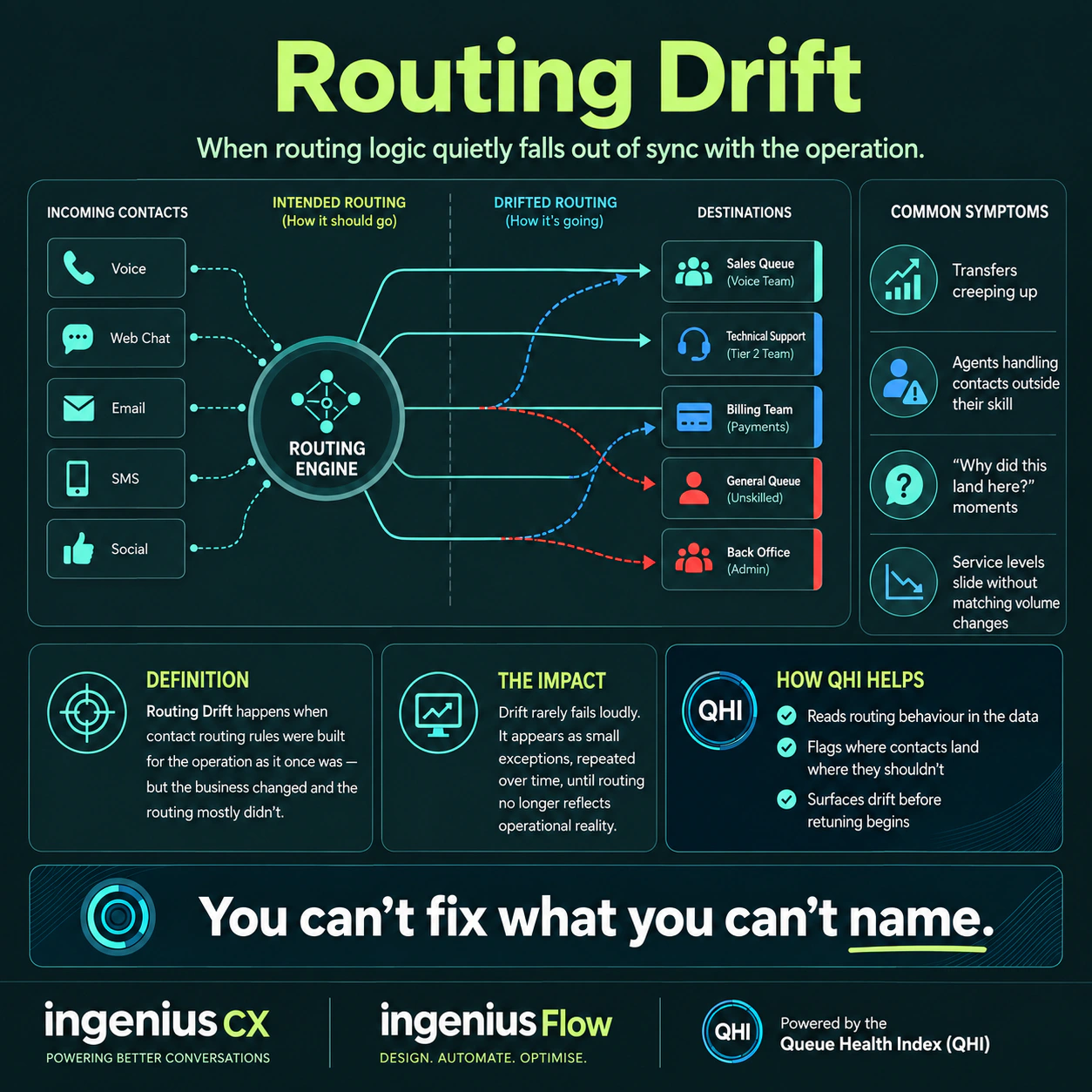
Nobody sets out to break their routing. It drifts.
Somewhere in the history of every contact centre is a moment when someone sat down and configured the routing to match the operation — the skills, the products, the teams, the volumes, exactly as they looked that day. It was correct. It worked.
Then the operation moved on, and the routing mostly didn't. That gap, widening quietly over months and years, is one of the most common and least visible problems in a contact centre. We call it Routing Drift, and it's the second of the named patterns the Queue Health Index is built to surface.
What Routing Drift is
Routing Drift is routing logic that has gradually fallen out of sync with the operation it was built to serve.
The rules didn't change. The world around them did. New products launched without new routing to match. Skills were added, retired, or redefined. Teams reorganised. Agents joined and left. Demand shifted between channels and times of day. Each of those changes was handled somewhere — but the routing config, the thing quietly deciding where every single contact lands, rarely got revisited to match.
So contacts keep being routed according to an operation that no longer exists. Not dramatically. Just slightly wrong, in more and more places, as the distance between "how we're configured" and "how we actually run" keeps growing.
Why it's hard to catch
Queue Sprawl at least leaves evidence you can count — a pile of dead queues. Routing Drift is harder, because it never fails loudly. There's no outage, no alarm. It surfaces as a scatter of small, individually forgivable symptoms:
Transfers creep up, because contacts land somewhere that can't fully handle them and get passed on.
Agents find themselves handling things just outside their skill — not often enough to escalate, often enough to notice.
Everyone has the occasional "why did this even land here?" moment, shrugs, and moves on.
Service levels slide in ways that don't track with volume — the numbers get worse without the demand explaining why.
Any one of these reads as noise. A one-off. Not worth touching the rules over. And that's exactly why drift accumulates: every symptom is dismissible on its own, so the underlying cause never gets addressed. The routing degrades one reasonable-looking exception at a time.
Why it's expensive
Drift taxes the operation in ways that compound.
It wastes capacity. Every misroute is handling time spent getting a contact to the right place instead of resolving it. Transfers, re-queues, and out-of-skill handling all consume agent time that produces no outcome for the customer.
It degrades the experience invisibly. A customer who gets transferred twice before reaching someone who can help doesn't file a complaint about routing — they just leave with a worse impression, and the operation never learns why.
It corrupts your workforce planning. If contacts aren't landing where the config says they should, then your forecasting, staffing, and skill planning are all built on a map that no longer matches the territory. You're planning around fiction.
It makes every other diagnosis harder. When routing has drifted, the queue-level numbers get muddied — a queue looks overloaded or underused not because of real demand, but because of where contacts are wrongly landing. You can't trust the metrics until you know the routing behind them is sound.
How to spot it
The tell for Routing Drift is misdirection that doesn't track with volume. Transfer rates and out-of-skill handling that rise while demand stays flat. Contacts consistently landing somewhere the configuration says they shouldn't. Queues whose behaviour only makes sense once you realise they're catching overflow the rules never intended.
You find it by comparing two things: what the routing config says should happen, and what the data shows actually happens. Where those two diverge — repeatedly, not occasionally — the routing has drifted.
Why naming it matters
You can't fix what you can't name. "The routing feels off" is a hunch. It doesn't tell anyone where to look, and it doesn't survive a client asking you to prove it.
"Your routing has drifted — these contacts keep landing on a skill that was retired two reorganisations ago, and it's driving your transfer rate" is a finding. It describes an observable divergence between the config and the behaviour, which means it holds up when challenged. That's the difference a named pattern makes: it turns a feeling into something defensible.
The Queue Health Index surfaces Routing Drift by reading the routing behaviour in the data and flagging where it's diverged from what the configuration intends — where contacts land somewhere they shouldn't, where transfers cluster, where the pattern of arrivals doesn't match the rules on paper. It shows you where the drift is; it doesn't fabricate a cause or invent numbers the data can't support.
What to do about it
Unlike Queue Sprawl, Routing Drift isn't a one-time cleanup — it's a reconciliation that has to become a habit, because the operation will keep moving whether the routing follows or not.
The work starts by re-baselining: take the routing as it exists today and check it against the operation as it exists today. Which skills still exist? Which products still route where they used to? Which rules were written for a team, a campaign, or a channel that's since changed? Most drift resolves into a set of rules that describe an operation that's gone, and once those are corrected, the small daily symptoms — the creeping transfers, the out-of-skill handling — tend to recede together.
The deeper fix is treating routing as something that needs periodic reconciliation rather than a set-and-forget configuration. An operation that changes every quarter needs its routing checked against reality at least as often. The centres that stay ahead of drift aren't the ones with perfect initial config — they're the ones that keep the config honest as the operation evolves.
Key pointsRouting Drift is routing logic that has gradually fallen out of sync with the operation it was built to serve.It never fails loudly — it shows up as creeping transfers, out-of-skill handling, mystery misroutes, and service levels that slide independent of volume.It wastes capacity, degrades the experience invisibly, corrupts workforce planning, and muddies every other diagnosis.The tell is misdirection that doesn't track with volume — a repeated divergence between what the config says and what the data does.The Queue Health Index surfaces it by comparing intended routing against actual routing behaviour, and points to where the two have diverged.
Routing Drift is one of the named patterns in the Queue Health Index methodology. To see how the full diagnostic works — the five operational dimensions, how confidence is weighted, and why automation potential is scored separately from queue health — read the QHI methodology.