
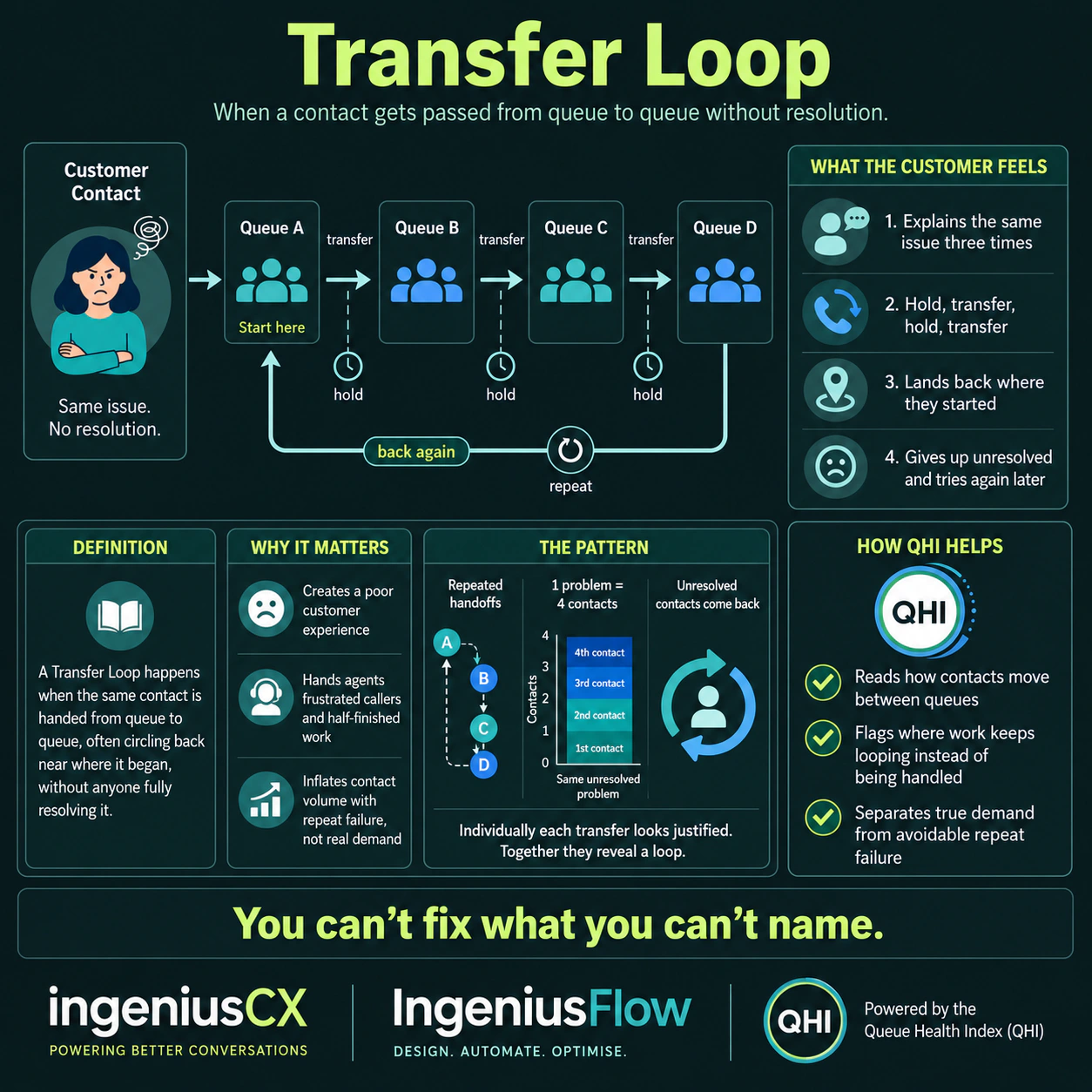
Every customer knows the sentence, and every customer has learned to dread it: "Let me transfer you to the right team."
They know what follows. They'll explain the whole thing again. They might get transferred a second time, or a third. And there's a genuine chance they end up talking to a team that has already passed them on once — back near where they started, no closer to an answer.
This is a Transfer Loop, and it's the fourth and final named pattern in the Queue Health Index series. It's also the one that breaks a rule the others share: Queue Sprawl, Routing Drift, and Wrap-Up Drag are all felt inside the operation. A Transfer Loop is felt by the customer, in real time, on the phone.
What a Transfer Loop is
A Transfer Loop is a single contact that gets handed from queue to queue — often circling back close to where it began — without anyone fully resolving it.
The distinction that matters is between a transfer and a loop. A transfer can be exactly right: a contact reaches the wrong place, gets moved once to the team that can actually help, and is resolved. That's the system working. A loop is what happens when that movement stops resolving anything — when the contact keeps getting passed along, each team handling a piece or none of it, until the customer gives up or lands back at a queue that already touched the case.
One transfer is routing. Repeated transfers that don't converge on a resolution are a loop.
How it happens
Loops are rarely one failure. They're the compound result of the other patterns in this series colliding.
When routing has drifted, contacts land in the wrong place to begin with — so the first transfer is already a correction, not a start. When queues have sprawled, there are too many plausible-looking destinations and no clear owner, so "not us, try them" is always an available answer. And ownership is the quiet root of it: at each hop, moving the contact on is easier than owning it to resolution, and no single queue is accountable for seeing it through. Every individual decision to transfer is defensible. The loop is what those defensible decisions add up to.
There's a structural accelerant too. A customer who hangs up mid-loop, unresolved, and calls back tomorrow doesn't appear in the data as a continuation. They appear as a brand-new contact. So the operation's own reporting erases the evidence that a loop happened at all — the failure re-enters the system disguised as fresh demand.
Why it's expensive
The customer pays first and most. Repeating yourself to three people, waiting through hold after hold, and ending up unresolved is one of the most corrosive experiences a contact centre can produce. It's the experience that turns a solvable problem into a lost relationship.
It multiplies workload. One unresolved problem becomes several contacts — the loop itself, plus every callback it generates. Agents inherit a caller who is already frustrated and a case someone else left half-finished, which makes each subsequent hop harder and slower than the first.
It corrupts the numbers in a specific, dangerous way. This is the part that misleads planning most. Loops and their callbacks inflate contact volume, so demand looks higher than it is. An operation can respond by staffing up to meet "rising demand" that is actually its own failure rate — paying more to handle the symptoms of a problem better routing would remove. Volume that is really repeat-contact noise gets mistaken for genuine load.
It hides from every standard report. Because the pieces are scattered across queues and callbacks register as new contacts, no single metric shows the loop. You have to follow the contact's path across queues to see it — and most reporting is built around queues, not journeys.
How to spot it
The tell is contacts that move without converging. Multiple transfers on a single case with no resolution at the end. Movement that returns a contact to a queue it has already visited. Transfer chains that are consistently longer than the work should require. And, read across days rather than within a call, callback patterns that suggest the same problem arriving again and again wearing the mask of new demand.
A legitimate escalation moves a contact toward resolution — up a tier, to a specialist, closer to an answer. A loop moves it sideways and back. Telling those two apart is the whole diagnostic challenge, and it's why the pattern needs to be looked for deliberately rather than read off a dashboard.
Why naming it matters
You can't fix what you can't name. Without the name, a Transfer Loop dissolves into unrelated symptoms — a transfer rate that looks a little high, some callbacks, a few customer complaints about being bounced around — each owned by a different report and none of them adding up to a cause anyone acts on.
Named, it becomes a single accountable finding: contacts are looping between these queues instead of resolving, and it's inflating your volume while punishing your customers. That's observable, checkable, and it points somewhere specific — which queue keeps passing the contact on, where the loop closes, what a customer actually experiences inside it.
The Queue Health Index surfaces Transfer Loops by reading how contacts move between queues rather than looking at each queue in isolation. It follows the path, flags where movement returns instead of resolves, and distinguishes a loop from a legitimate escalation. It reports the movement it can observe in the data; it doesn't infer intent it can't see or manufacture recovered-volume figures the data won't support.
What to do about it
Each pattern in this series has its own remedy shape. Sprawl is a one-time cleanup, Drift is a reconciliation habit, Drag is a process audit. A Transfer Loop is fixed by assigning ownership.
Start by tracing the actual loops: which contacts move without resolving, and where they circle. The paths usually implicate a small number of handoff points — a queue that receives contacts it can't resolve and can't confidently place, so it passes them on. Those are the seams to fix first.
Then make resolution someone's job at each seam. A loop persists because passing the contact on is easier than owning it; the fix is to make ownership the default — clear accountability for seeing a contact through, and a routing path that carries enough context that the next team isn't starting from zero. Much of the misery in a loop is the re-explaining, and much of the re-explaining exists because context doesn't travel with the contact.
Because loops are downstream of the other patterns, they also tend to ease when those are addressed. Correct the routing drift and fewer contacts start in the wrong place. Clear the queue sprawl and there are fewer wrong places to be sent. A Transfer Loop is often the symptom that finally makes the upstream problems visible — the point where the operation's internal debt becomes something a customer can feel.
Key pointsA Transfer Loop is a single contact passed from queue to queue — often circling back near where it began — without anyone fully resolving it.It's the one pattern in the series the customer feels directly: repeating themselves, held and transferred, landing back where they started.It multiplies workload and inflates volume — one unresolved problem becomes several contacts, so failure disguises itself as demand.The tell is movement without convergence: repeated transfers, returns to queues already visited, and callbacks that are really the same problem again.The Queue Health Index follows contacts across queues, flags where movement returns instead of resolves, and tells a loop apart from a legitimate escalation.
Transfer Loop is one of the named patterns in the Queue Health Index methodology. To see how the full diagnostic works — the five operational dimensions, how confidence is weighted, and why automation potential is scored separately from queue health — read the QHI methodology.