
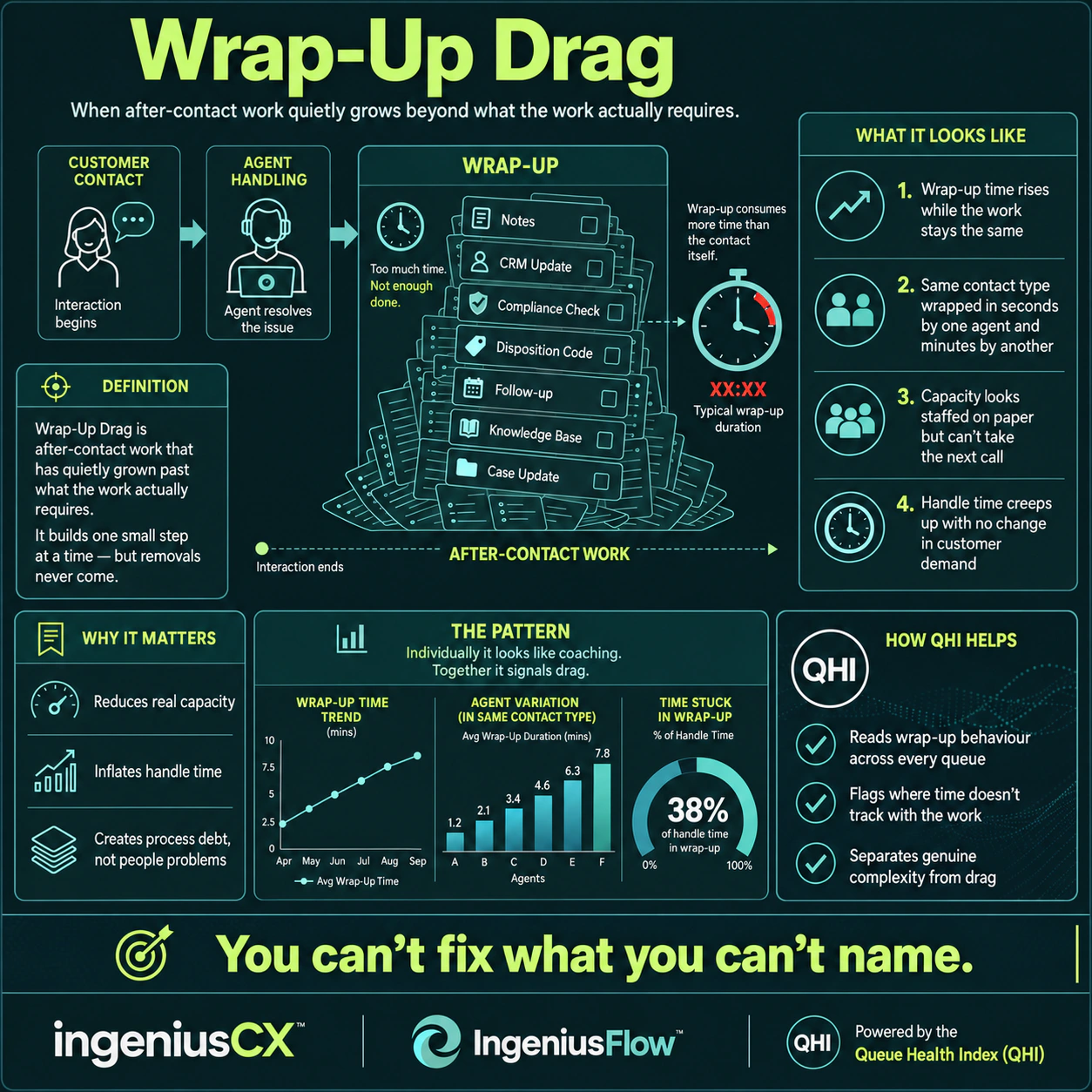
When wrap-up time starts creeping, the diagnosis is almost always the same: the agents are slow. Coach them. Target them. Tighten the after-call allowance.
It's usually the wrong diagnosis — and an expensive one, because it aims the intervention at people when the cause is process. The time after every contact has a structural habit that has nothing to do with who's working that day: it only ever grows.
We call the result Wrap-Up Drag, and it's the third of the named patterns the Queue Health Index is built to surface.
What Wrap-Up Drag is
Wrap-Up Drag is after-contact work that has grown beyond what the work actually requires — wrap-up time that no longer reflects the effort of closing a contact, but the accumulated weight of every system, step, and box added since the process was first designed.
It accretes the same way Queue Sprawl does, one level down. Sprawl is an operation accumulating queues it doesn't need; Drag is a process accumulating steps it doesn't need. Every new system adds fields to update. Every compliance change adds a step. Every process fix adds a code to select, a note format to follow, a box to tick. Each addition arrives alone and looks reasonable on its own. Removals almost never arrive at all, because nobody in the operation owns the question "what can agents stop doing after a call?"
There's a second, quieter contributor. Wrap-up is the one state where the agent controls the clock. When the day is relentless, wrap-up becomes the recovery buffer — the only place to breathe between contacts. That isn't a character flaw; it's a signal about workload. But it means the wrap-up number stops measuring documentation effort and starts absorbing whatever the schedule refuses to give people any other way.
Why it's hard to catch
Nobody experiences wrap-up. It sits between contacts, not inside them — so no customer ever complains about it, and no complaint ever points at it. It doesn't fail loudly; it just thickens.
Reporting doesn't help. Wrap-up is usually buried inside handle time or shown as an average, and averages are precisely the wrong lens for this pattern. Drag lives in the variance — in the gap between what closing a contact should take and what the accumulated process now demands, and in the spread between agents doing identical work. Average it all together and the number looks stable while the debt underneath keeps compounding.
Why it's expensive
It's paid time with no customer outcome. Wrap-up produces documentation, not resolution. Some of it is genuinely necessary — records matter, compliance matters. Past that point, every additional second is pure cost: time the operation pays for that moves nothing forward for anyone.
It shrinks capacity invisibly. An agent in wrap-up is staffed on paper and unavailable in practice. The roster says the seats are covered; the queue says otherwise. Left long enough, the operation starts buying headcount to cover time a process is consuming — hiring to fund its own debt.
It hardens into planning. Handle-time assumptions quietly absorb the drag. Forecasts, staffing models, and budgets all get built on the inflated number, and at that point the inefficiency is structural: the operation is no longer carrying the debt, it's planning around it.
It lands on the wrong people. The visible symptom reads as "agents are slow," so the intervention goes at agents — coaching plans, tighter targets, league tables. Morale pays the bill, and the actual cause survives the intervention untouched, ready to produce the same numbers next quarter.
How to spot it
The tell is wrap-up time that doesn't track with the work.
The same contact types wrapped in seconds by one agent and minutes by another — the work is identical; the drag isn't. Wrap-up rising after a system rollout while the contact mix stays flat. Times clustering tight against whatever maximum the allowance permits — the shape of a buffer being used, not a task being finished. Handle time creeping upward while what customers are actually asking for hasn't changed.
Any one of these is dismissible. Together they describe a process that has drifted away from the effort it was built to capture.
Why naming it matters
This is the pattern where the name earns its keep most, because the wrong name blames people.
"Agents are slow" is an accusation. It triggers coaching programmes, tightened targets, and a defensive fight with the very team the operation depends on. "You have Wrap-Up Drag — after-contact work that has accreted past what closing a contact requires, and it's absorbing capacity you're staffing to replace" is a finding about process. It's observable, it's checkable, and it survives being challenged — and because it doesn't indict anyone's team, it gets accepted rather than argued with. A finding a client accepts is a finding a client acts on.
The Queue Health Index surfaces Wrap-Up Drag by reading after-contact behaviour across every queue and flagging where the time doesn't track with the work. Context matters here, and the engine respects it: a queue tagged as genuinely complex — tier-3 technical support, say, where heavy documentation is the job — is expected to carry heavier after-contact work, and isn't flagged for doing so. Drag is the unexplained weight: wrap-up out of proportion to what the queue actually handles. The engine flags what it observes in the data; it doesn't guess at causes, and it doesn't invent recovered-hours figures the data can't support.
What to do about it
Each pattern in this series has its own remedy shape. Sprawl is a one-time cleanup. Drift is a reconciliation habit. Drag is an audit of the work itself.
Sit with the wrap-up and count what it actually asks of an agent: how many systems, how many fields, how much of it is the same information entered more than once. Strip the duplication first — it's the purest waste in the stack. Then automate the mechanical parts: pre-populated fields, templated notes, a disposition list short enough to pick from without scrolling. Set expectations by contact type rather than one blanket allowance, because a complex technical case and a password reset should never share a target.
And if wrap-up is being used as the recovery buffer, read that as workload information rather than a discipline problem. Fixing the schedule beats policing the state.
Then guard the gains. Drag re-accretes by default: every time a new system or compliance step gets added to wrap-up, something should be asked to leave. Until removal is somebody's job, the growth resumes the moment the audit ends.
The capacity recovered from Wrap-Up Drag is the cheapest capacity an operation will ever add. It's already on the payroll — sitting in the quiet stretch after every contact, waiting for the process to stop asking so much of it.
Key pointsWrap-Up Drag is after-contact work that has grown beyond what the work actually requires — process debt accumulating in the time between contacts.It accretes the way sprawl does: systems, compliance, and process fixes keep adding steps, and nothing ever removes them.It's expensive because it's paid time with no customer outcome, it shrinks capacity invisibly, it hardens into planning assumptions, and it gets blamed on agents instead of process.The tell is wrap-up time that doesn't track with the work — identical contacts, very different drag, visible in the variance rather than the average.The Queue Health Index separates genuine complexity from unexplained drag using per-queue context — a queue where heavy documentation is the job isn't flagged for doing its job.
Wrap-Up Drag is one of the named patterns in the Queue Health Index methodology. To see how the full diagnostic works — the five operational dimensions, how confidence is weighted, and why automation potential is scored separately from queue health — read the QHI methodology.